
































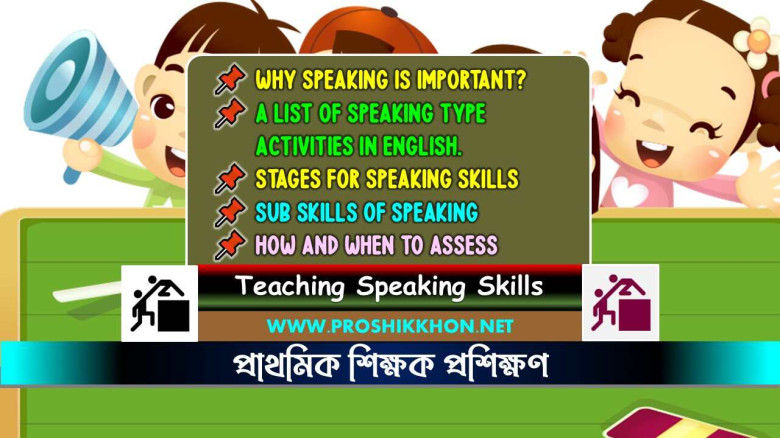
Teaching Speaking Skills
প্রাথমিক শিক্ষক প্রশিক্ষণ | Primary
Teachers Training
Teaching
Speaking Skills
বলার দক্ষতা শিখন-শেখানো কৌশল
Why Speaking is Important?
The importance of Speaking:
✨ Children who speak English can access a wider range of
information and resources using online platforms.
✨ Children who speak English will have access to
different cultures.
✨ Children who speak English will have access to
understand English movies, dramas, news etc.
✨ Children who speak English will have access to learn
new vocabulary and improve their listening comprehension.
✨ Children who speak English will have to understand how
English is used in real life.
✨ Speaking helps the students to develop listening,
reading and writing skills.
✨ Speaking can make students feel that English is an
interesting subject that they want to learn.
✨ Speaking English may be very useful in students’ future lives.
✨ Speaking is one of the four skills of the English Primary Curriculum in
Bangladesh. One of the main objectives of Classes 1-5.
Make
a list of Speaking activities what we do in our primary English classes.
A
list of Speaking type activities:
✨ Look, listen and
repeat
✨ Say in pairs
✨ Look, listen and
say
✨ Look, listen,
repeat and say
✨ Listen and say
in pairs
✨ Listen and say
the missing words
✨ Listen and
repeat
✨ Count and say
✨ Repeat after
your teacher in pairs
✨ Recite in pairs
✨ Listen and sing
✨ Listen, say and
read
✨ Recite and act
out the rhyme
✨ Listen, say and
point to the right picture
✨ Ask and answer
in pairs
✨ Look and say
✨ Make a dialogue
✨ Describe the
picture
✨ Say about your
family
✨ Listen, say and
read.
How many stages for Speaking skills we
do in our primary English classroom?
There are three stages for Speaking
skills we do in our primary English classroom. Those are:
✨ Controlled Speaking
✨ Guided Speaking
✨ Free Speaking.
What
are the activities that can be used to practice speaking?
Techniques
used in Speaking:
✨ Teaching Vocabulary,
✨ Chorus drilling,
✨ Chain drilling,
✨ Open pair work
(Demonstrate how to do it),
✨ Pair practice,
✨ Open group work
(Demonstrate how to do it in group),
✨ Group Practice,
etc.
What
are the sub-skills of speaking?
There
are two main aspects of the speaking skill. Those are:
1) Accuracy: It
means to be correct in terms of different language points e.g. grammatical
forms, rules, pronunciation etc.
2) Fluency: It means
to speak/write smoothly.
When
and how to correct speaking?
1. Finding the mistakes during pair/group work:
When
students are working in pairs or groups, teacher can walk around and listen to
as many students as possible. He/she can make notes about common mistakes.
2. Controlled practice (chorus drill, chain drill/pronunciation
practice):
Teacher
can arrange a controlled activity after the pair/group activity without
mentioning which pair/group did the mistakes.
It helps them avoid making similar mistakes next time they use the
language, and in this way helps them improve their English.
How
and when to assess speaking?
Here are some suggestions for assessing speaking skills. You may
have more ideas- add them to the list:
✨ Teachers can
regularly ask questions of all students in the class. At the end of the lesson,
teachers make notes on the students’
performance. Teachers can do this over time – for
example, they can ask 6 different students each time, making sure that they ask
all students in the class eventually (and not always the same students, for
example, the students having roll no. first, middle, last or the more confident
students).
✨ When students are
working in pairs or groups, teachers can walk around the room and listen and
make notes. It will be impossible for teachers to monitor each pair or group
for every activity. Teachers can assess 3 or 4 different groups each time.
✨ Teachers can give
oral tests to individuals or small groups of students. Teachers can give oral
tests to pairs over a period of time – when
other students are doing pair work.
মতামত দিন