


















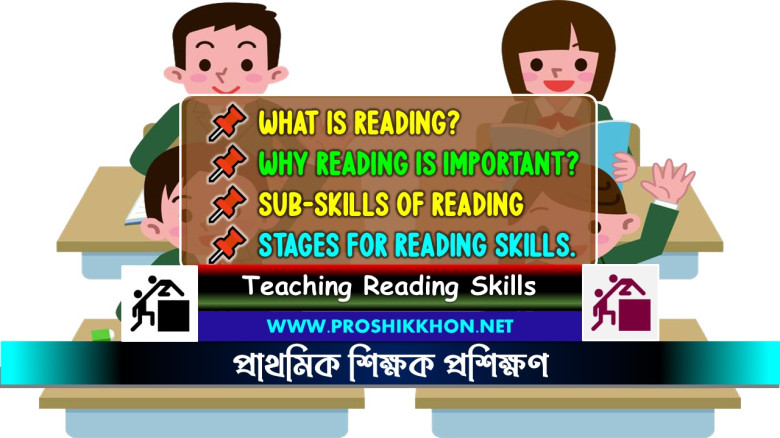
Teaching Reading Skills
প্রাথমিক শিক্ষক প্রশিক্ষণ | Primary
Teachers Training
Teaching
Reading Skills
পড়ার দক্ষতা শিখন-শেখানো কৌশল
What is reading?
Reading is a cognitive process.
Generally reading is defined as a process whereby as look at and understand
what is written. It means understanding a text. To read a written language is
called reading.
Why Reading is Important?
The importance of Reading:
✨ Reading helps recognizing the script
of language.
✨ Without developing the reading
skills, we cannot acquire knowledge.
✨ By reading, vocabulary of the
learners can be increased.
✨ Reading helps the readers to understand the
meaning of various topics.
✨ Reading helps self-development and
forms personality of the learners.
✨ Reading helps developing
intelligence and creativeness of the learners.
✨ Reading helps for the recreation of
the learners.
✨ Reading helps to introduce the cultural heritage of
different nations.
What are the sub skills of Reading?
Sub
skills of Reading:
1) Predicting:
Guessing what a text will be about, for example looking at the title,
picture or keywords.
2) Skimming:
Reading quickly to understand the main ideas in a text.
3) Scanning:
Reading quickly to find a particular piece of
information.
4) Reading for detail:
Reading very carefully to understand as much information
in the text.
5) Reading for pleasure:
Reading because you want to and because you are
interested in the text.
How many stages for Reading
skills we do in our primary English classroom?
Stages of Reading Skills:
There are mainly three
stages of reading. They are-
1) Pre-reading: Pre-teaching and practicing
vocabulary; predicting topics using pictures; task to engage learners’ interest in the text.
✨ showing text
pictures and asking to describe the picture
✨ showing the
title and then asking questions about what the text will be
✨ teaching new
words which help to understand the text
2) While-reading: Doing reading activities to hold the
attention of the students. while-reading (tasks for skimming, scanning and
detail; task for focusing on the meaning of difficult vocabulary) activities
e.g. jigsaw, quiz, reading race, jumbled texts, running dictation.
✨ Fill in the
gaps- Keep the students attentive in reading and check understanding.
✨ Identify True
or false- Keep the students attentive in reading.
✨ Exact meaning
questions- Teacher can check the understanding of the text.
3) Post-reading: Activities (speaking and writing
tasks) for checking students’ understanding.
✨ Teachers may provide some inferred-meaning questions or questions related
to students’ own experiences.
✨ Students have to use their own words to answer these types of questions. These questions involve thinking about the text and understanding the links between ideas.
মতামত দিন