



























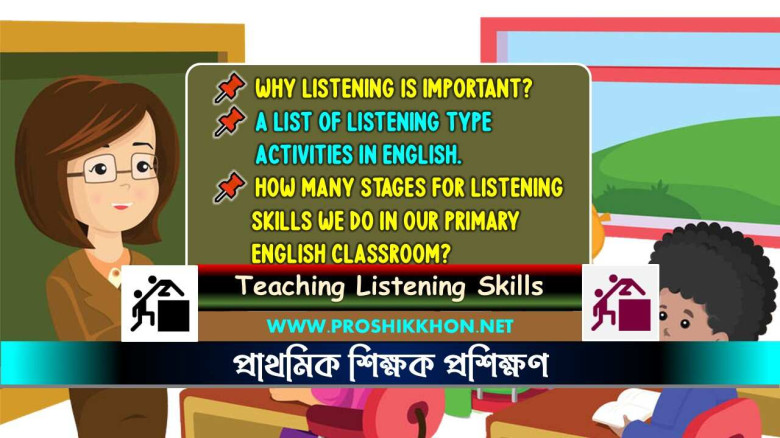
Teaching Listening Skills
প্রাথমিক শিক্ষক প্রশিক্ষণ | Primary
Teachers Training
Teaching
Listening Skills
শোনার দক্ষতা শিখন-শেখানো কৌশল
Why listening is Important?
The importance of listening:
✨ Listening is essential for effective communication.
✨ Listening builds trust and rapport (better
relationship).
✨ Listening is essential for learning.
✨ Listening can help us to be more productive.
✨ Listening can help us to make better decisions.
✨ Listening can help us to solve problems more
effectively.
✨ Listening can help us to develop empathy.
✨ Listening is essential in resolving conflicts.
✨ It is easier for young children to listen to English
than to read and write it.
✨ Children will often understand much more than they
can say or write.
✨ If students listen to a lot of English, they will be
able to pick up more words and phrases.
✨ Some children learn better when they hear
information, rather than seeing it.
Make a
list of listening activities what we do in our primary English classes.
A list of
listening type activities:
✨ Look and
listen
✨ Listen and repeat
✨ Look, listen
and repeat
✨ Look, listen
and say
✨ Look,
listen, repeat and say
✨ Listen and
say in pairs
✨ Listen and
say the missing words
✨ Listen and
repeat
✨ Recite in
pairs
✨ Listen and
sing
✨ Say the
missing numbers
✨ Listen, say
and read
✨ Listen, say
and point to the right picture
✨ Look and say
✨ Ask and
answer
✨ Listen say and read, etc.
How many stages for listening skills we
do in our primary English classroom?
There are three stages for listening
skills we do in our primary English classroom. Those are:
1) Pre-listening
2) While listening
3) After listening.
Three stages for listening skills in
details with examples:
1) Pre-listening:
This is the stage before the listening actually begins. It is to
get ready with prior knowledge, set a purpose for listening, and guess about
the listening topics.
Activities for Pre-listening:
✨ Didactile support (flash card,
pictures…….)
✨ brainstorming,
✨ previewing,
✨ predicting,
✨ guessing,
✨ eliciting etc.
2) While listening:
This is the stage when actually listening continues. It is to
focus on understanding the main points of the topic, identifying important
details, and following the speaker's thoughts.
Activities
for While Listening:
✨ top-down
(general for the gist),
✨ bottom-up
(details/for specific info),
✨ word
completion,
✨ matching,
✨ true/false,
✨ chart
filling etc.
3) Post-listening:
This is the stage after the listening has ended. It is to reflect
on what have heard, answer questions or given activities, and summarize the
main points.
Activities for Post Listening:
✨ composition,
✨ storytelling,
✨ sentences,
✨ role play etc.
এ ধরনের আরও পোস্ট পড়ুনঃ
মতামত দিন